
karmic
Karmic designs, writes, tests, and deploys firmware for Arduino, ESP32, STM32, RP2040, and more.
Works with your favorite hardware
The best way to build with agents
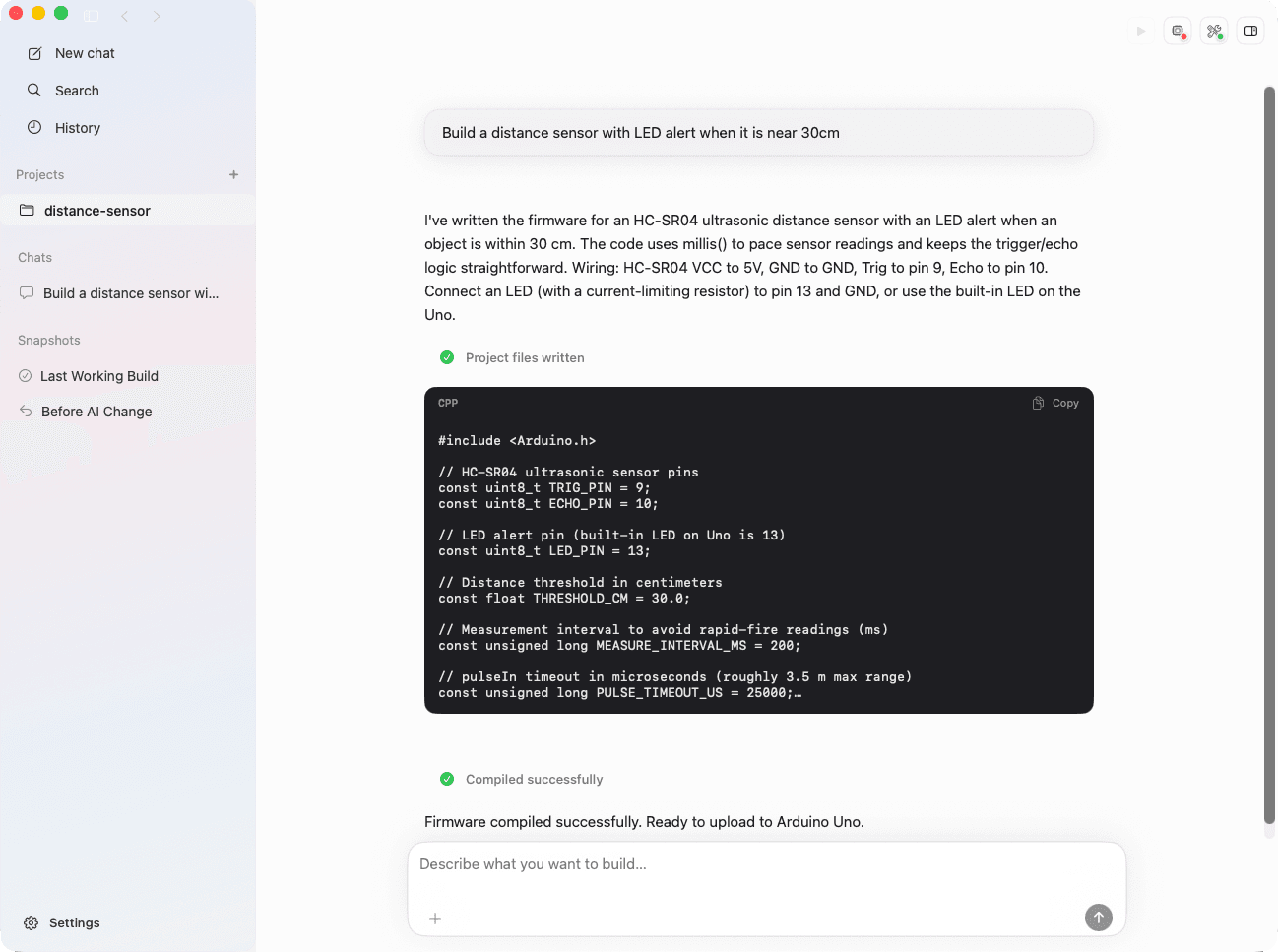
Karmic translates natural language to secure, efficient, hardware-optimized code and pushes it to devices seamlessly.
Board-Aware Pinout & Mapping
Avoid spending hours reading pinout datasheets, mapping register addresses, and troubleshooting conflicts. Karmic automatically detects your microcontroller, maps analog and digital pins, and configures hardware interfaces (I2C, SPI, UART) with zero conflict.
Non-Blocking Signal Loops
Standard code relies on delay() functions that freeze the entire processor. Karmic generates event-driven, non-blocking state machines and hardware interrupts automatically. Your device stays responsive to network calls, user inputs, and sensor interrupts.
Safe-State Hardware Emulator
Test your code in a safe virtual space before putting it on physical boards. Karmic runs your code through an emulated chip environment to catch buffer overflows, infinite loops, and power surge threats, saving your hardware from shorts or bootloops.
Zero-Setup Cloud Toolchains
Skip the pain of installing GCC-AVR, Esptool, USB drivers, or platform-specific IDEs. Karmic wraps compiler toolchains and linker scripts inside isolated dev environments. Compile your binaries and flash them directly over WebUSB/serial in one click.
OTA Fleet Update & Telemetry
Easily update and monitor your remote hardware post-deployment. Karmic integrates secure wireless flashing protocols and lightweight telemetry endpoints directly into your firmware, allowing you to track battery levels, heap health, and deploy updates wirelessly.
Loved by builders, hackers, and engineers
See how makers are utilizing the Karmic AI hardware development assistant to build physical prototypes in minutes.
I vibecoded a complete distance-based alarm system in less than five minutes. Karmic felt like using Cursor but for physical devices. Truly magical.
Karmic configured our entire serial signal loop and mapped pins automatically. The automated firmware generator writes compile-ready C++ code that flashes microcontrollers natively.
As an engineering consultant, prototyping is 80% of my work. Using Karmic as an AI hardware development assistant shaved days off configuring GPIO pin structures.
I was skeptical about AI coding for microcontrollers due to strict timing constraints, but Karmic's compiled CircuitPython loops are clean, non-blocking, and highly readable.
Vibecoding hardware devices is a game-changer. We designed, flashed, and tested a customized agricultural sensor node tree in a single afternoon.
The visual pin routing sidebar and real-time diff compilation outputs give me high-fidelity feedback. Karmic has simplified serial port flashing on macOS completely.